


1 Corinthians 7:29-31
Scripture: 1 Cor. 7:29 This is what I mean, brothers: the appointed time has grown very short. From now on, let those who have wives live as though they had none,
1 Cor. 7:30 and those who mourn as though they were not mourning, and those who rejoice as though they were not rejoicing, and those who buy as though they had no goods,
1 Cor. 7:31 and those who deal with the world as though they had no dealings with it. For the present form of this world is passing away.
Teaching: Taken out of context, these verses can create all sorts of errant advice and thought, particularly in verse 29, “let those who have wives live as though they had none”...yikes! But thankfully, context can clear this up. Throughout this chapter, Paul has been giving pastoral advice, not as a command for righteousness nor a direct quote from Jesus, but as one who sees life through the lens of salvation and eternity. He said that those who are married should remain married and those who are single are good to remain single (salvation doesn’t make either less desirable or more sinful). To those who are married to an unbeliever, Paul advises that they do what they can to remain married, but their first priority is not their spouse’s desires but Christ.
Our security in salvation underpins all of Paul’s advice. Because we are eternally secure, by grace through faith, in Christ, we free to see our lives now in a new light. Your allegiance is to Christ before a spouse, children, or even to self. As Paul mentions in verse 26 and in 29, he particularly notes the challenging times Christians live in (being persecuted for their faith) and the shortness of time in which to live for Christ in this life. This leads him to his advice in verses 29-31, that each person saved by Christ should not accept an excuse for failing to serve Christ in this life, nor live in a distracted manner. The days are short, Christ has put a call on your life – will you obey it? Or will your attention be divided?
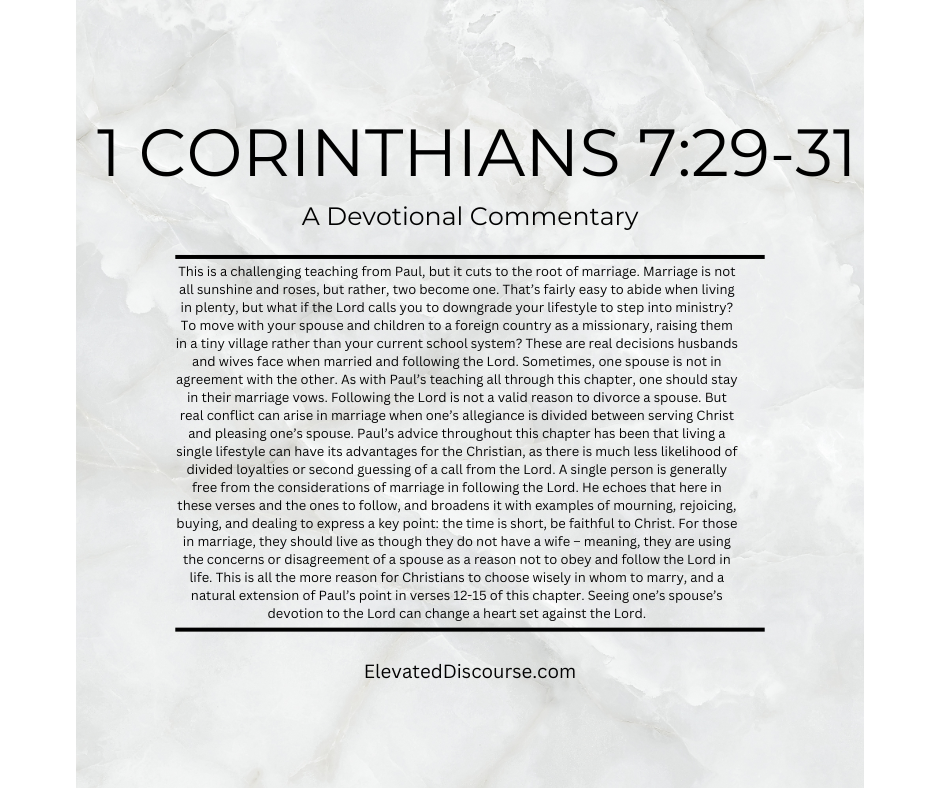
Takeaway: This is a challenging teaching from Paul, but it cuts to the root of marriage. Marriage is not all sunshine and roses, but rather, two become one. That’s fairly easy to abide when living in plenty, but what if the Lord calls you to downgrade your lifestyle to step into ministry? To move with your spouse and children to a foreign country as a missionary, raising them in a tiny village rather than your current school system? These are real decisions husbands and wives face when married and following the Lord. Sometimes, one spouse is not in agreement with the other. As with Paul’s teaching all through this chapter, one should stay in their marriage vows. Following the Lord is not a valid reason to divorce a spouse. But real conflict can arise in marriage when one’s allegiance is divided between serving Christ and pleasing one’s spouse. Paul’s advice throughout this chapter has been that living a single lifestyle can have its advantages for the Christian, as there is much less likelihood of divided loyalties or second guessing of a call from the Lord. A single person is generally free from the considerations of marriage in following the Lord. He echoes that here in these verses and the ones to follow, and broadens it with examples of mourning, rejoicing, buying, and dealing to express a key point: the time is short, be faithful to Christ. For those in marriage, they should live as though they do not have a wife – meaning, they are using the concerns or disagreement of a spouse as a reason not to obey and follow the Lord in life. This is all the more reason for Christians to choose wisely in whom to marry, and a natural extension of Paul’s point in verses 12-15 of this chapter. Seeing one’s spouse’s devotion to the Lord can change a heart set against the Lord.
Comments